
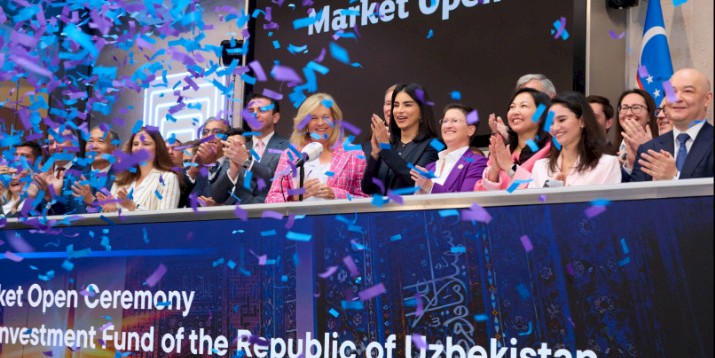
UzNIF’s London Listing: A Landmark Test for Uzbekistan’s Privatisation Drive
Svetlana Alexeeva
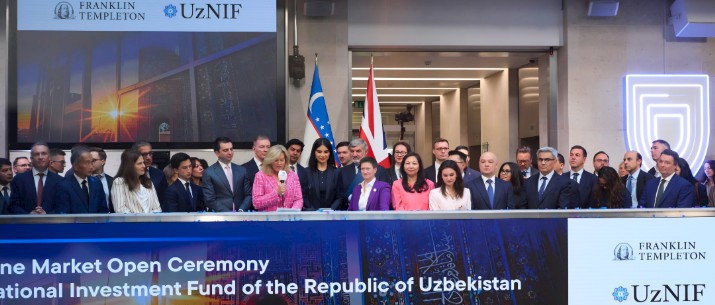
Uzbekistan marked a historic moment in London on 18 May 2026, as the National Investment Fund of the Republic of Uzbekistan (UzNIF) made its debut on the London Stock Exchange (LSE). The transaction represents a major step in opening Uzbekistan’s capital markets to global investors. The offering was structured as a dual listing in London and Tashkent. On the LSE, global depositary receipts (GDRs) of UzNIF attracted major international cornerstone investors including BlackRock and Franklin Resources underlining growing foreign appetite for exposure to the Central Asian country’s fast-growing economy.
The listing of the state-backed Uzbek entity is significant not only as a capital markets transaction, but also as a strategic signal of Uzbekistan’s reform ambitions. Established in 2024, UzNIF is closely linked to the country’s broader privatisation agenda and serves as one of the country’s key investment vehicles for introducing international governance standards and foreign capital into strategic assets. The Fund holds minority stakes in 13 major state-owned enterprises across different sectors including aviation (Uzbekistan Airways), telecommunications (Uzbektelecom), hydropower (Uzbekhydroenergo), electricity grids, gas distribution and banking (SQB). In this respect, UzNIF offers international investors a diversified entry point into some of the country’s most important economic assets, while also supporting the government’s effort to modernise and partially privatise the state sector.
A Milestone in Uzbekistan’s Transformation Since 2017
The IPO marks a significant milestone in Uzbekistan’s wider economic transformation. When Shavkat Mirziyoyev became president in 2016, the country was a closed, state-dominated economy, characterised by currency distortions, strict capital controls, limited foreign investment and a weak position in international business climate rankings. Since then, the government has pursued a broad reform agenda focused on currency convertibility, price liberalisation, tax simplification and the gradual reduction of state dominance in key sectors. International financial institutions, including the World Bank and the Asian Development Bank, have supported this transition through financing, policy advice and technical assistance. The economic results have been strong. According to the World Bank, real GDP growth averaged around 6% annually between 2017 and 2025. Foreign investment has also increased substantially.
Privatisation as a Gradual Reform Process
Uzbekistan’s privatisation process has advanced in phases. In recent years, the government has sold or liquidated hundreds of smaller state-owned enterprises and transferred thousands of state-owned properties into private hands. For larger and more strategic assets, however, the process has been more gradual. The focus has been on restructuring, improved financial reporting, the adoption of IFRS, stronger ESG practices and corporate governance standards more closely aligned with OECD principles. In these efforts, UzNIF plays a key bridging role. It helps selected state-owned companies to professionalise governance and capital-market readiness, with the aim of value creation, greater transparency and, over time, full or partial divestment.
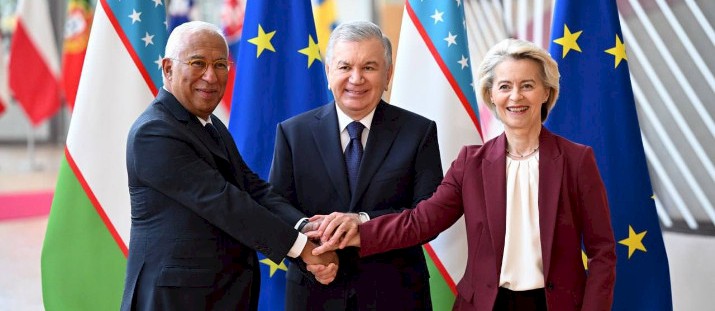
The UzNIF IPO is therefore directly connected to Uzbekistan’s long-term reform and modernisation programme. President Shavkat Mirziyoyev has repeatedly emphasised the need to accelerate privatisation, reduce the state’s economic footprint and support private-sector-led growth. In London, Uzbekistan was represented at the official UzNIF IPO ceremony by Saida Mirziyoyeva, Head of the Presidential Administration, and Obid Khakimov, Deputy Advisor to the President on Economic Policy. The initial placement was strongly received by the market. The offering generated more than $2.8 billion in investor demand and raised approximately $603.6 million through the sale of a 31% stake. At the offer price, UzNIF’s market capitalisation was approximately $1.95 billion. For Uzbekistan, this first major international equity listing was a key test for future IPOs of state-linked assets – and by that measure, it was successful. The transaction demonstrated that international investors are prepared to engage with Uzbekistan when reform progress, credible governance structures and access to strategic assets are combined in a transparent capital-market instrument.
Opportunities for European and German Investors
For European and German investors, UzNIF offers exposure to a reforming frontier market with several attractive structural characteristics: a young and growing population of more than 38 million people, rich natural resources, rising infrastructure needs and an economy that has maintained strong growth momentum in recent years. Uzbekistan’s improving sovereign credit profile supports the investment case. The country is now broadly in BB country ranking territory BB rating territory. This remains below investment grade, but it reflects a stronger macroeconomic and reform profile than in earlier stages of the country’s transition.
The broader geopolitical and economic context also matters. Uzbekistan is increasingly relevant to European interests, first of all, improving regional connectivity, particularly in regional connectivity through routes such as the Middle (Trans-Caspian) Corridor, as well as in renewable energy, critical raw materials and supply-chain diversification. For Germany, which is seeking more resilient economic partnerships beyond traditional markets, Uzbekistan is becoming an important partner in Central Asia.
UzNIF gives investors a diversified entry point into this story. At the same time, they should approach UzNIF with a clear understanding of frontier-market risk. Liquidity, governance execution, political influence, currency exposure and the pace of future reforms will remain important considerations. UzNIF should therefore be viewed as a long-term strategic investment case rather than a short-term trade. The potential reward lies in early exposure to a market that is still underrepresented in global portfolios. If Uzbekistan continues to deliver on privatisation, governance reform and capital-market development, UzNIF could become an important vehicle for international participation in the country’s next phase of economic transformation.
Picture © Svetlana Alexeeva
Contact the author: Svetlana.Alexeeva@digital-insight.de
2026-05-19

BOTSCHAFTER IN BERLIN
Hier finden Sie alle wichtigen Informationen über die ausländischen Botschaften in Berlin von A wie Afghanistan bis Z wie Zypern. Schauen Sie doch mal rein unter www.botschafter-berlin.de.
MONATSBRIEF
Wenn Sie sich für unseren kostenlosen Monatsbrief anmelden möchten, senden Sie bitte eine Nachricht.
LESER ÜBER UNS




Impressum | Datenschutzerklärung
© Diplomat Media Berlin 2017 —