
“German Brigade in Lithuania is a Landmark”
Lithuania is the Partner Country of this year’s Berlin Security Conference. The Baltic state is an important part of NATO’s eastern flank with a close relation to Germany expressed by the German Brigade in Lithuania. BUSINESS & DIPLOMACY talked Ambassador Giedrius Puodžiūnas about his country’s role within Europe’s security policy and Lithuania’s concept for the EU Council Presidency in 2027.
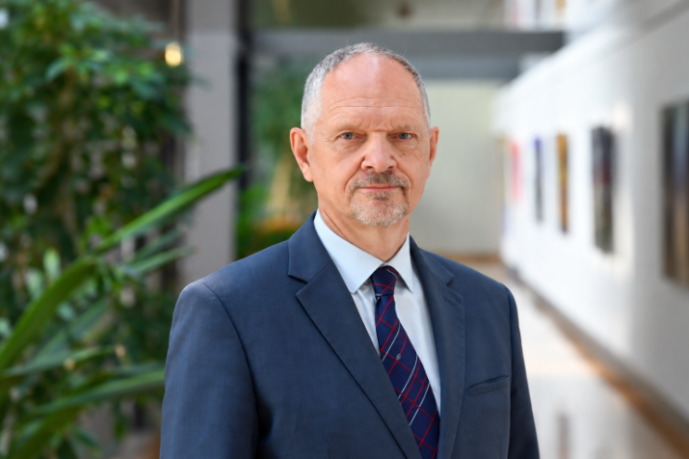
Lithuania is the Partner Country of this year’s Berlin Security Conference. What does Lithuania intend to emphasise during the conference, particularly given the current situation in foreign and defence policy?
As Partner Country of the Berlin Security Conference 2026, Lithuania wants to emphasize, that European defense is requiring Europe to move from political statements to concrete defence capabilities.
Our central message is that defending NATO’s eastern flank means strengthening the entire Alliance. Europe must take greater responsibility for its own defence and build a stronger European pillar within NATO, while maintaining a strong transatlantic partnership. This requires credible deterrence, military readiness, resilient infrastructure and a stronger European defence industry.
We will also underline the importance of sustained support for Ukraine. A secure, independent Ukraine capable of defending itself makes Europe stronger, while its battlefield experience and technological innovation offer valuable lessons for the future of European defence.
Finally, having in mind the fact that Russia’s threat is long-term and systemic Lithuania wants to demonstrate how frontline experience can contribute to European security, from total defence and societal resilience to cyber defence and new military technologies. The conference should help turn these shared priorities into practical cooperation, industrial investment and capabilities that strengthen our collective defence.
How serious is Lithuania’s security situation with respect to the Suwałki Corridor and the Kaliningrad region?
Lithuania takes these security challenges seriously and continuously assesses developments in the Kaliningrad region and around the Suwałki Corridor, but not in isolation, but as a part of broader picture of wider defense and security environment in whole eastern flank of NATO . The latter is strategically important because it connects the Baltic States with the rest of Allied territory, making its security a shared NATO responsibility.
At the same time, Lithuania’s security is not considered in isolation. NATO’s regional defence plans, strengthened presence on the eastern flank and improved reinforcement arrangements provide a strong foundation for collective defence. Lithuania is also investing substantially in its armed forces, military infrastructure, host-nation support and civil preparedness.
Our approach is based on deterrence and readiness, not alarmism. By strengthening our own defence and ensuring that Allied forces can operate and reinforce effectively, we contribute to a stronger European pillar of NATO and a more credible Alliance capable of defending all its members.
What are Lithuania’s expectations regarding the German Brigade in Lithuania? What is its current status?
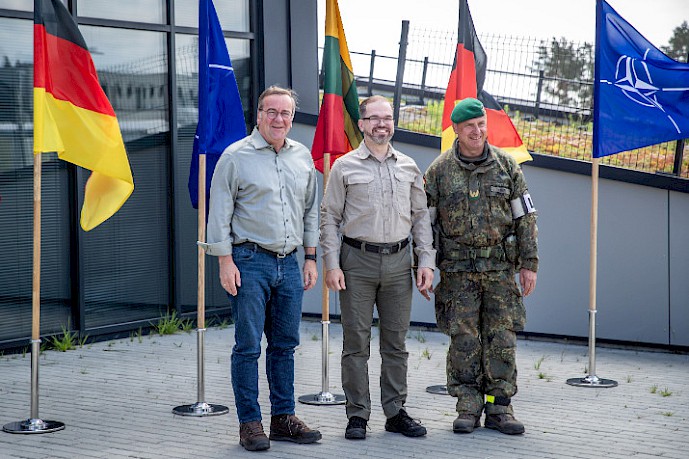
The German Brigade in Lithuania is a landmark in our bilateral relations and a concrete demonstration of Germany’s long-term commitment to European security. Our priority is the full implementation of the agreed deployment plan and the establishment of a combat-ready brigade that strengthens NATO’s forward defence.
Lithuania is committed to build the military infrastructure, training areas, accommodation and logistics needed to support the deployment. The objective is for the brigade to become fully operational by the end of 2027, with approximately 5,000 German military and civilian personnel expected to serve in Lithuania. The 1-st phase of Rudininkai military base is already completed, several month ahead of time.
The brigade represents more than a permanent military presence. It demonstrates integrated defence through joint operational planning, interoperability and sustained cooperation. It is also a practical example of how European Allies can take greater responsibility for collective defence through concrete commitments and capabilities. We see it as a lasting expression of German-Lithuanian trust and Allied solidarity.
In Germany, some critics argue that the Bundeswehr is not sufficiently prepared for a potential defence scenario. Are there concerns on the Lithuanian side?
Germany is not an exception, the same kind of critics we observing everywhere else including in Lithuania. This is the natural reaction of public, which is concerned of own secure future. Lithuania views Germany as a highly reliable ally and an indispensable contributor to European security. The decision to permanently deploy the 45th Armoured Brigade in Lithuania demonstrates Germany’s commitment to taking greater responsibility for the defence of Europe.
Like other NATO Allies, Germany faces the challenge of translating increased defence investment into operational readiness, modern equipment and sustainable military capabilities. We welcome the efforts undertaken through the Zeitenwende and see the German Brigade as tangible progress in strengthening NATO’s eastern flank.
Beyond military readiness, Europe must also expand its defence-industrial capacity and accelerate the delivery of essential capabilities. Lithuania is developing its own defence industry, with priorities including drones and counter-drone systems, maritime drones, ammunition and explosives production, military equipment assembly and logistics. We offer a secure NATO environment, political commitment and opportunities for industrial cooperation and scaling up production.
We therefore see Germany as both a key military ally and a strategic industrial partner. By combining German capabilities and industrial strength with Lithuania’s frontline experience and growing defence sector, we can strengthen European defence and make the Alliance better prepared for future challenges.
In the first half of 2027, Lithuania will take over the Presidency of the EU Council. Which topics will Lithuania emphasize during its Presidency?
Lithuania will assume the Presidency of the Council of the European Union at a particularly consequential moment for Europe. Russia’s war against Ukraine continues to shape the European security environment, while at the same time the European Union faces growing pressure to strengthen its competitiveness, accelerate innovation and prepare for future enlargement. In this context, maintaining European unity and the capacity to act will remain essential. As Council Presidency, Lithuania will act as an honest broker among Member States, while contributing its experience in areas where Europe faces particularly urgent challenges.
First and foremost, security and defence will remain at the centre of Europe’s agenda. Lithuania will work to ensure sustained political, military, financial and humanitarian support for Ukraine and to keep Ukraine firmly on its European path. We will continue promoting a strong European stance against Russian aggression, strengthening sanctions, addressing sanctions circumvention, and countering hybrid threats. We also expect important discussions on Europe’s long-term security architecture, including the implementation of the forthcoming European Security Strategy, stronger defence capabilities, economic security and closer transatlantic cooperation.
A second key priority will be EU enlargement. Lithuania has consistently supported the European aspirations of Ukraine, Moldova and the Western Balkan partners. We believe enlargement is one of the EU’s most successful strategic instruments for promoting stability, democracy and prosperity across Europe. We will therefore seek to maintain momentum in accession negotiations and support candidate countries in advancing the necessary reforms.
Competitiveness and innovation will be other major focus. Europe must become a more attractive place to invest, innovate and scale businesses. During Lithuania’s Presidency, significant legislative work is expected on initiatives aimed at strengthening Europe’s competitiveness, including support for start-ups and innovative companies, reducing fragmentation within the Single Market, promoting advanced technologies such as artificial intelligence, cloud infrastructure, semiconductors and biotechnology, as well as reinforcing resilient supply chains and economic security.
Lithuania will also pay particular attention to internal security and societal resilience. Hybrid attacks, cyber threats, disinformation, critical infrastructure protection and emergency preparedness increasingly require coordinated European responses. Strengthening resilience is not only a security issue, but also a prerequisite for economic stability and public trust.
Finally, social security and social cohesion will remain an important dimension of the European project. Europe’s competitiveness must go hand in hand with opportunities for citizens, support for vulnerable groups and policies that strengthen social resilience in times of rapid economic and technological transformation.
Lithuania has always believed that a stronger Europe begins with unity, responsibility and the willingness to act. These principles will guide our Presidency across all major policy areas.
Interview: Rainer Schubert
2026-10-30

BOTSCHAFTER IN BERLIN
Hier finden Sie alle wichtigen Informationen über die ausländischen Botschaften in Berlin von A wie Afghanistan bis Z wie Zypern. Schauen Sie doch mal rein unter www.botschafter-berlin.de.
MONATSBRIEF
Wenn Sie sich für unseren kostenlosen Monatsbrief anmelden möchten, senden Sie bitte eine Nachricht.
LESER ÜBER UNS




Impressum | Datenschutzerklärung
© Diplomat Media Berlin 2017 —